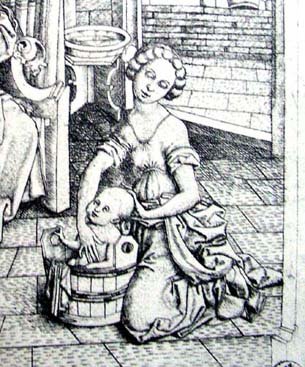
Birth:
Surviving
childhood is difficult, especially these first few years when
your immune system is getting acquainted with the numerous
germs and diseases of the Medieval world. Infant mortality
rates are very high.
Hospitals
in the modern sense, do not exist at this time; as so, births
take place at home. Doctors and nurses are also very different
occupations and it is most common to be prepared and attended
by a "midwife".
Being a christian Empire, it is extremely important to have
the baby baptized as soon as possible, as infant death rates
are very high. Those of the Upper-class and Middle-class have
their babies baptized at the church on the very day of their
birth, as death without baptism condemns the soul to Limbo.
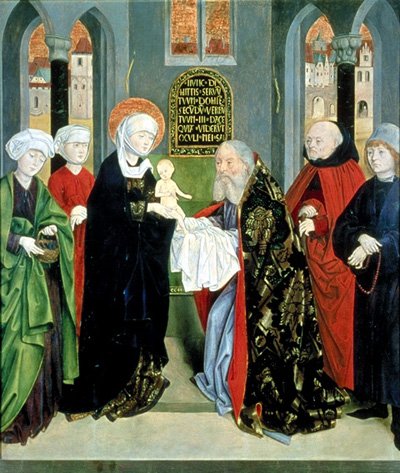
The
child's own mother did not attend the Baptism as the Church
considered her impure for a certain number of days after the
labor. To restore a woman's purity, a ceremony known as "churching"
is employed.
After childbirth, the mother is normally required to attend
the parish church for a ceremony. Leviticus 12:4-5 prescribed
that the ceremony occur 33 days after the birth of a male
child and 66 after the birth of a female child.
The
mother attends the church accompanied by two married women.
She is veiled and carries a lighted candle. At the church
porch, she is met by the priest who, accepts the white chrism
cloth in which the child had been baptized. Before she being
allowed to enter the church, she is sprinkled with holy water
by the priest. Once allowed inside, she is ritually readmitted
to the communion (mass) and to the community of the faithful
by the priest reciting Psalm 120 (121) over her.
Childbirth
is a difficult task in the Middle Ages. Pain is regarded as
the curse of Eve, where no attention is paid to the agony
or to the possibility of complications. Gynecology and obstetrics
are not only ignored, but the suggestion that there should
be some concern in these fields is regarded as evidence of
a sick mind. As a consequence, many women die in childbirth
-- and many more go mad
Even
if one survived the birth, she risked something called childbed
fever -- a term almost unknown now -- which killed a significant
percentage of mothers.
Many
times, even if the mother survived childbirth, it is a distinct
possibility that the infant would die. The low life expectancy
of the middle ages is largely a result of infant mortality.
All in all, it is a very hard experience, and few have any
real sympathy for the mother. The women deserved all of this
torment, as partial expiation for the sexual pleasure which
have led to the birth, and, at a greater remove, for Eve's
sin. |