|
On her
husband's death, a widow automatically received a third of
her late husband's property for use during her lifetime, unless
his will specifies otherwise (Gies and Gies, City 69). A peasant
widow, however, often inherited all of her husband's worldly
goods and land. Though she might be pressure to remarry (to
ensure that the lands would be worked), she could maintain
her independence by hiring workers (Gies and Gies, Village
107). Peasant widows in England had to pay heriot, or death-tax,
to their husbands' liege lord. Heriot usually consisted of
the family's best beast, or its equivalent in cash (109).
Pregnancy
and delivery were fraught with hazards. Midwifery, though
crucial to a pregnant woman's survival, was primitive. Breach
presentations of children were not handled easily; Caesarian
section was reserved for cases when either mother or child
was dead, and then it was performed without anaesthesia or
antiseptics (Gies and Gies, City 58). A woman's life expectancy
was twenty-four. Few people, men included, could expect more;
most people died before the age of thirty (Manchester 55).
If a woman survived her childbearing years, she stood a good
chance of outliving her husband to marry again (Gies and Gies,
City 58). People who made it to the thirty-year milestone
might well live to be a ripe old fifty or sixty -- but a medieval
woman at thirty might resemble a modern woman at sixty (Manchester
55).
A dying
woman received extreme unction, the last chronologically of
the seven Christian sacraments. Her soul was commended to
God and would be saved from the torments of Hell. (However,
if the woman recovers after receiving the last rites, she
must live a life similar to a nun's -- poor, chaste, and penitent.)
The corpse was anointed, wrapped in a shroud, sewn up in a
leather sack, and placed in a coffin. Mourners in black followed
the funeral procession to the body's final resting place --
which might not have been its final resting place. The body
could have been dug up a few years later and placed in a charnel
house so the grave could be reused (Gies and Gies, City 74;
Village 126-7).
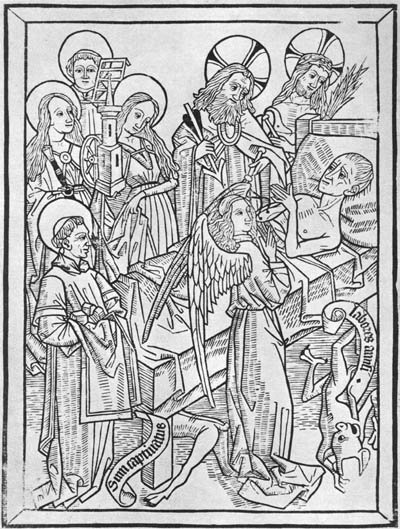
"Art
of Dying" 1470's woodcut
|