
Magnus Kompanie Aufgebot Hesse 1471-1499
Feel free to leave comments to the staff, we appreciate everyone's input.
|
|
Magnus Kompanie Aufgebot Hesse 1471-1499Feel free to leave comments to the staff, we appreciate everyone's input. |
|
 |
eing a Living History group based in the land of Hesse, of the Holy Roman Empire during the 1470s. |
|
|
Our group specializes in bringing history to life as our members accurately recreate life in the Holy Roman Empire during the 1470s. From military impressions to their families and suppliers who followed in the wake of the soldiers on the march. Magnus Kompanie is a re-enactment and living history group dedicated to exemplifying the lives of men and women from Hessen-Kassel (Germany) during the time of the Holy Roman Empire; the era of 1471-1499. Such a unit may have been Landwehr (militia) who might have served the city and surrounding area, or a Reislaüfer (foreign war mercenaries) unit who might have served in England's War of the Roses.All conjecture is based on research of period documents and treaties on the subject. While most research is aimed at Germany during the 1470's, many holes have to be filled in with research of surrounding areas such as Fleming, a German-speaking dutchy. |
|
|
|
|
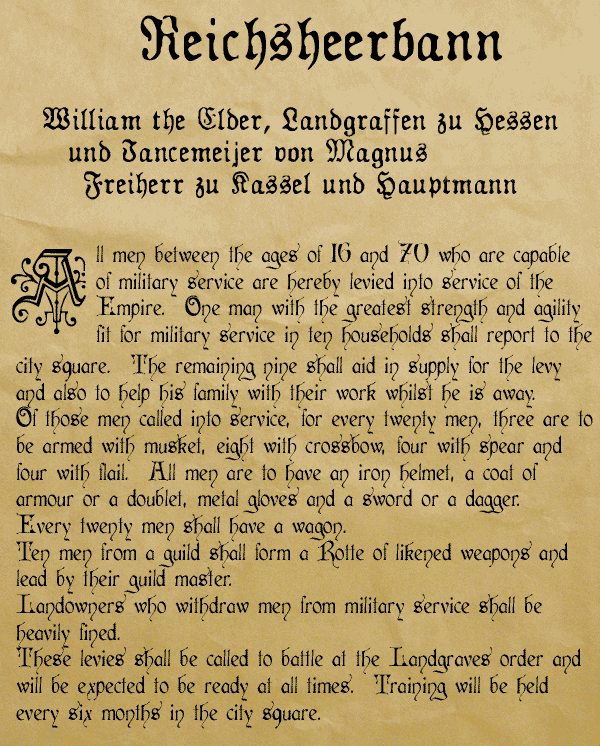
| The Reichsheerbann is an official notice for raising a militia. The example above is based on contemporary evidence. | |
The most famous Imperial military mobilization of the High-Gothic era: the Siege of Neuss has been linked to Hesse-Kassel, the city that birthed Magnus Kompanie! Phillip de Commynes relates that the siege of Neuss started because the Landgraf of Hesse, our lord, was bidding to have his brother placed as the [arch-] bishopric of Cologne. The other contestant was a relative of the count-palatine of the Rhine. To which the duke of Burgundy took the side of the palatine and undertook to place the claimant in office by force. His mobilization was also with the hopes to capture several places along the Rhine. He besieged Neuss near Cologne in 1474. The landgrave of Hesse and some soldiers were inside the town. The Duke of Burgundy believed that by garrisoning Neuss, if he were able to take it, he could then move on to another town or two above Cologne. Thus Cologne, a major influence upon the Rhein, would be forced to capitulate. The landgrave of Hesse and many of his relatives and friends, with up to eighteen hundred horsemen as I have been told, had stationed themselves inside the town of Neuss. All of them were fine soldiers, as they were to demonstrate. They also had as many infantry (possibly even us) as were necessary. The landgrave, our Lord, was brother of the elected bishop who was the opponent of the man supported by the duke of Burgundy. So the duke besieged Neuss in 1474 (on the 30th of July). |
|