"Hauptmann"
(Captain)
This
is the Man In Charge. Usually he is the guild master from
the city or a foreign mercenary in the pay of the Landgraf.
Either way he is the end-all be-all of the Army.
|
"Wachtmeister"
(Captain
of the Guard)
Very
important indeed is the Wachtmeister.
Referred to as the "Captain of the Guard" in England,
this man carried great status and more important, reputation.
Rarely did the Wachemeister need a personal bodyguard to do
his job, if he was good at it, his mere presence brought troops
into line.
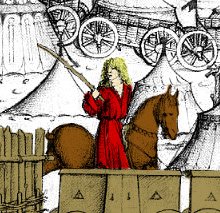
The
Wachtemeister ensured that codes were being adhered to, duties
were being followed and laws were being enforced. He rode
astride his horse through the camp, armed with a baton, a
symbol of his authority, being used as a switch to painfully
bring rule into order without crippling the soldier, so that
he may fight as needed the next day.
|
"Pfennigmeister"
(Master of Penny, actually, the
one with the Cash),
|
| "Geschützmeister"
(Master of multiple Cannons), |
"Quartiermeister"
(master of Quarters, the one who tells you where
to put your tent) |
"Proviantmeister"
(Master of Foodstuff, not a
cook) |
"Fürer/Rottmeister"
(leads 10 halberdiers, or likened small squad or armed soldiers) |
| "Weibel"
(who's status is like a sergeant in modern army's) |
"Troßweibel"
(sergeant of the Equipment, wagons, etc) |
| "HurenWeibel"
(sergeant of the baggage train and camp followers) |
"Schreiber"
(Captains secretary and document officiate) |
"Pfeiffer"
(fife/pipe musician)
|
"Trommelschläger"
(drummer musician)
|
"Kaplan"
(chaplain)
|
"Knechte"
(in service to the army, all armed men without rank) |
"Büchsenknecht"
(soldier with a fire arm)
|
"Stangen/Spießknechte"
(halberd or pike soldier) |
"Stangen/Spießknechte"
(halberd or pike soldier)
|
"Fußknechte"
(foot soldier, most common term for all armed men without rank) |
"Junge
beim Hauptmann" (boy in service to the Hauptmann)
Like
any squire serving under a knight, the Junge is a youth given
to the Captain to learn the ways of being a Kreigherren, or
a lord of battle.
|
"Jungen/Mädchen"
(boy and girl)
Families
who follow in the baggage train will also raise children on
the march. |
"Armbruster"
(soldier with a crossbow)
|
"Fähnrich"
(soldier who carries the flag, pennant or guide on)
The
standard bearer is one of the most looked-up to soldiers in
the entire assembly. Only the bravest and most battle-honored
of soldiers is given the honor of carrying the standard. Such
a standard might display the heraldic arms of Hesse, or the
city, or of the Hauptmann himself.
Smaller
pendants and flags denoting each squad are also an honor among
squad-mates, but means little compared the the standard bearer.
|
"Armbruster"
(soldier with a crossbow)
|
"Glücksritter
" (a mercenary knight) |
"Fahrender
Ritter" (a knight errand)
|
|
Special
thanks to Wolf from Hamburg for his contributions. For without
his help, none of this would be outlines so well and completely. |
Advancement
in the Komapnie
Advancement
is ceremonially rewarded as recognition for the effort put
into your research, impression and kit. Ranks here are given
as a sign of accomplishment, but lack any authority unless
voted upon or divvied out by the Hauptmann. In the end, all
members of the Kompanie are here of their own free will and
love for history and the hobby.
Authority
is not given to be pressed upon our members or anyone else.
Everyone knows what is expected of them and responsibility
is as free and highly regarded in our group as constitutional
rights. If someone is breaking the rules, they may be asked
to leave. If anyone is unhappy, they are free to leave. Any
authority given is done so on the bias that the one it is
awarded to is mature and responsible enough to be able to
handle it appropriately and not cause anyone in the group
hardship, bad feelings or give them cause to feel they must
leave the group.
In
this group, fun and fairness rules, not the Officers. Everyone
is expected to work together to enjoy themselves at every
outing!
Addendum:
Our group is more concerned with Historic Authenticity than
with Modern military-equivalent ranks. But in an effort to
give levels of achievement for group members to strive for,
I have attempted to divide sections based on the amount of
research and time spent on your impression and in the group,
as well as the gear acquired.
Note
that the main body of our military mobilization is as a militia
raised from the city of Kassel.
Only
after enough members have been recruited to fill a unit of
halberdiers can other units be began. Artillerie, Handgonne,
Cavalry and Mercenary groups are all acceptable additions
to this Kompanie once we have enough people to accomplish
them.
While
the Hauptmann of Magnus Kompanie will retain his position
for life, Field Officers are voted positions. Any Officer
wanting to hold his station is expected to have the required
gear to accurately portray his station.
To
attain any of the following levels, the candidate must be
able to give a short speech on their impression. |
New
Members (considered a "Bauer" or peasant)
As
a new member, your required kit is lenient. Within the first
six months to a year, you will be expected to have one full
set of clothes.
Both
sexes should have
- correct
leather shoes or boots.
|
A
man should have
- linen
briefs and undershirt,
- wool
vest or doublet
- wool
hosen (split or full)
- points
to tie the hosen to the vest or doublet
-
a hat or hood.
|
A
woman must have
-
linen chemise
- wool
under dress (or simple dress) known as a kurtle,
-
a linen head-wrap.
|
Full
members (paying thier dues yearly and attending at least one
event a year)
By
now, you should have a better grasp of the education-side
of the group. At this point, you should have your own necessities
and a more robust wardrobe. As well as what is required
for new members you should have the following...
The
pouches and purses may carry personal items that should
not be seen by the public but may be needed, such as an
asthma inhaler, reading glasses, your wallet, keys, etc,
not to mention money in both modern and reproduction currency.
Both
sexes should have
-
a canvass travel sack of a size capable of holding the
following items of which you should also have...
-
period correct fork and eating knife,
- sturdy
carved wooden bowl,
- sturdy
simple drinking vessel (pewter, tin, clay, etc.).
- Any
other personal items not of period correct manufacture
may be hidden inside this sack.
also:
-
a bedroll. The bedroll itself resembles a sleeping bag,
except you do not get inside of it. In the 15th century,
these had straw in them; which meant they also had bugs.
If you want to go that route, make sure you clean it and
replace the straw with a fresh supply before EVERY event.
Otherwise, it is preferred you fill it with tow (scraps
of material or wool), cotton filler, down, feathers, whatever
that is durable and will not attract vermin or mold and
can be washed frequently (such as newer camping foam pads).
Like a sleeping bag, at the foot of the bedroll should
be two leather straps and buckle sets so that it may be
rolled up and secured for travel. If you want a pillow,
keep it in your travel sack until bedtime.
|
Men
will need
-
wool coat
-
a belt with correct fixtures
-
a pouch or purse attached to the belt.
- a
dagger, sheathed (ALWAYS SHEATHED) behind his pouch or from
his belt.
|
Women
will need
- the
overdress
-
a ladies belt with correct fixtures
-
a pouch or purse.
|
Advanced
member (paying yearly membership, attending at least 2 events
a year and helping with organization)
At
this point you should be very serious about historic authenticity
and researching all the little nick-knacks that make a simple
impression seem amazingly life-like. By now, you should
have all of the previous levels’ requirements and the following…
Both
sexes should have
- Wicker
traveling basket (that can be strapped to your back like
a backpack) or a chest, or a bucket, or a barrel (dry
or wet-make). These more sturdy carrying devices can display
any other historic-correct items when open to the public
in a very correct and more realistic way, or these can
be sealed to hide items you do not want viewed by the
public, but make the camp much more comfortable and durable
than the canvass travel sack allows.
Each
family unit should have
-
a correct tent.
- The
spoke-wheel tent is preferred and much more economical.
It is easily erected by 1-2 people and quite comfortable,
as well as being the single most common tent of the era.
- The
“double belled wedge” as some designate it, was also popular
in Britain, France and Burgundy. While not so much in
Germany, it is an affordable alternative and looks very
nice once painted with stripes of sealant over the seems
and roof.
- Another
less interesting but applicable alternative is a bivouac.
This is simply a rectangular piece of canvass pinned to
the ground at one end and raised by wooden supports on
the other. This is far more common for someone with a
storefront, but works as an incredibly less-expensive
alternative.
|
| questions?
Contact the Hauptmann |